
How to see Lupins on route to Milford Sound in 2026

Across New Zealand, lupins and pine forests have become familiar features of the scenery.
They’re photogenic and often loved by visitors, but both plants play a far more complex role in New Zealand’s natural environment.
Here, we explore why lupins and wilding pines are considered pest species, how they affect the landscapes they grow in, and the work being done to manage them.
Gaining this context doesn’t diminish their beauty, but adds another element to the story of Fiordland and the wider landscapes of Aotearoa.
Key Takeaways
Russell lupins were introduced intentionally in the 1940s to beautify roadsides, but they spread rapidly and have negative impacts on the environment
Lupins flower from mid-November to early January, with December offering the most reliable displays along the Milford Road and through the Eglinton Valley.
Wilding pines have spread across more than two million hectares of New Zealand, forming dense forests that outcompete native vegetation and alter water flows, fire risk, and ecosystem health.
Both species were introduced with good intentions, but flourished without natural predators, becoming some of the country’s most widespread pest plants.
Large-scale conservation programmes are underway, supported in part by visitor funding through the International Visitor Levy.
What Is a Pest Plant in New Zealand?
New Zealand hosts over 30,000 introduced plant species that arrived here either deliberately or accidentally, and most of these never spread beyond gardens or farms. Around 2,500 have become naturalised, meaning they sustain wild populations without ongoing human help. Of these naturalised introduced plants, around 300 species are classified as environmental weeds, or pest plants.
These plants earn pest status, not just because they come from somewhere else, but because they behave invasively. They grow fast, reproduce readily, and outcompete the native plants that evolved to survive in New Zealand’s nutrient-poor soils and unique climates.
Without their usual predators or diseases to keep them in check, the pest plants can dominate landscapes, smothering native vegetation, altering soil chemistry, and disrupting habitats relied on by native birds, insects, fish, and lizards.
Russell Lupins in New Zealand

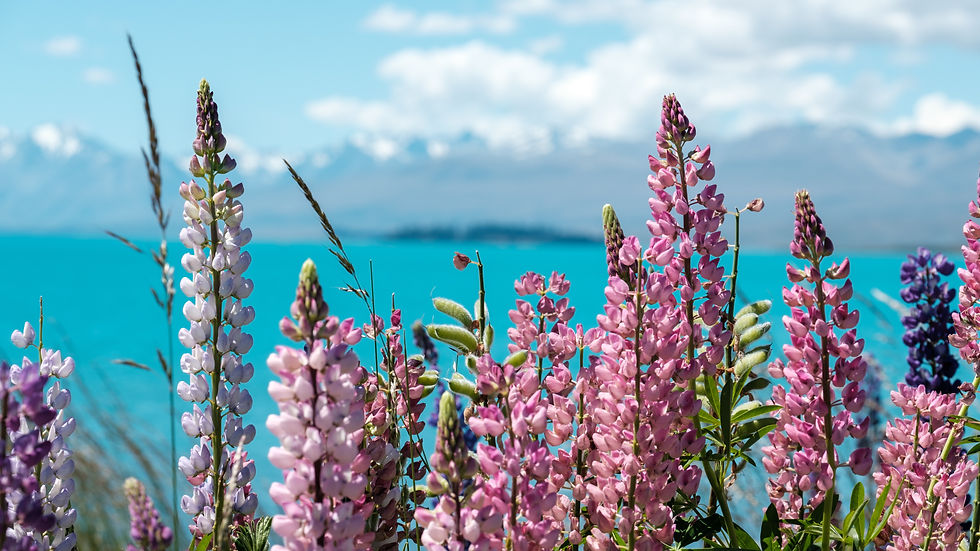
Russell lupins began as ornamental hybrid plants developed by British horticulturist George Russell between 1911 and 1937. His colourful “Russell Hybrids” quickly became popular garden plants around the world, admired for their height and vibrant flowering displays.
In New Zealand, though, these same plants have flourished far beyond garden boundaries and now characterise many South Island roadsides and riverbeds.
Their rise in the wild can be traced back to one well-meaning lady named Connie Scott, who lived at Godley Peaks Station near Lake Tekapo. In 1949, Connie bought £100 of lupin seeds and scattered them along the roadsides, hoping to “make the world more beautiful.”
Her contribution became so well known that her gravestone at Burkes Pass cemetery remembers her as “The Lupin Lady.” Unfortunately, her good intentions have resulted in a multimillion-dollar pest control problem.
Why Lupins are Considered Pests
Lupins are considered pests in New Zealand because they are non-native plants that spread aggressively and damage native ecosystems.
As legumes, lupins enrich low-nutrient soils with nitrogen. By changing soil chemistry, they create conditions that favour other invasive species while making life harder for the native plants adapted to New Zealand’s naturally nutrient-poor soils.
Lupin stands can also reach 1.5 metres tall and form dense thickets, especially along braided rivers. These rivers need constant movement of gravel and shingle, but lupins stabilise the small river islands that should shift with flood events. This changes water flow, creates deeper and faster channels, and removes gravel habitat essential for native birds and fish.
Many critically endangered bird species, like black stilts (kakī), also depend on open gravel for nesting. Lupins block their nesting sites and provide cover for predators like stoats, ferrets, and rats to approach unseen.
Each lupin plant can produce seeds of up to 1000 kilograms per hectare that remain viable for more than a decade, and their pods burst open in summer heat, flinging seeds several metres away. Over time, this enables lupins to expand rapidly across riverbeds, roadsides, and open valleys, making long-term control challenging.
Where You'll See Lupins in Fiordland

While Lake Tekapo is the epicentre of New Zealand's lupin displays, Fiordland's populations are equally impressive. In Fiordland, lupins are most visible along the Milford Road through the Eglinton Valley.
The areas around Deer Flat and the Cascade Creek DOC campground often host the largest concentrations, where the colourful blooms line the roadside and river edges from early to late summer.
When Lupins Flower
Lupins bloom from mid-November through to early January, with December usually providing the most consistent displays. Although the official flowering season stretches from September to February, the most vivid colours appear during early summer. Blooms typically emerge first around Lake Tekapo before reaching Fiordland a little later in the season.
Are Lupins Dangerous?
Lupins contain alkaloids that can be toxic to livestock if eaten in large amounts, though some farmers use them as supplementary feed when managed carefully. Sheep are the most vulnerable due to their smaller body size, and the seeds carry the highest concentration of toxins when chewed or crushed.
For people, lupins pose no health risk. Photographing or walking near them is safe. The main concern for visitors is unintentional spread. Lupin seeds can stick to clothing, shoes, or gear, allowing them to be carried into new areas where they may establish and contribute to further invasion.

Conservation Efforts and What Visitors Can Do
The Department of Conservation puts significant amounts of hours and resources into plant pest management every year, including spraying lupin stands in braided river systems where the invasions are most severe.
Many regional councils have regulations for lupins in their regional plans that landowners must follow to protect the environment, such as not planting within 200 metres of braided river channels.
Visitors can help by not picking lupin flowers or collecting seeds, as this contributes to the spread problem.
Although their environmental impact is clear, there’s no denying that lupins are beautiful, and they’ve become part of the visual experience many travellers associate with New Zealand’s South Island. Visitors can absolutely enjoy seeing and photographing them while also being mindful of their impact, appreciating the scenery without helping the plants spread further.
Wilding Pines in New Zealand

Wilding pines is the term used for introduced conifer trees that spread beyond where they were originally planted. Although many were brought to New Zealand for forestry or erosion control, they now regenerate freely across open landscapes, and over two million hectares are affected nationwide.
The most aggressive species is contorta pine, but other species, such as Douglas fir, radiata pine, ponderosa pine, and Scots pine, also spread readily. Mature trees release thousands of tiny seeds each year, and strong winds can carry them many kilometres, enabling rapid expansion into fragile ecosystems.
Many wilding pine stands trace back to large-scale plantings in the mid-20th century, when government programmes spread seeds widely, even by aircraft, in the hope of stabilising eroding high-country slopes. Concerns were raised as early as the 1960s, but coordinated national control did not begin until 2016 with the launch of the National Wilding Conifer Control Programme. Contributions from the International Visitor Levy help fund this control work.
Why Wilding Pines Are Problematic
Wilding pines outcompete native plants by growing fast and forming dense, light-blocking canopies that destroy habitat for native species. Tussock grasslands, which are home to native birds, insects, lizards, and plants, are especially vulnerable. Once pines establish, they can quickly transform open valleys and alpine slopes into closed forests.
Wilding pines are also extremely thirsty species, and their high water use reduces stream and river flows, affecting irrigation, hydroelectric generation, and native fish habitat. Without management, these trees can alter entire landscapes within a few decades.
Walter Peak: A Restoration Success Story

One successful restoration project occurs at Walter Peak on Lake Wakatipu Near Queenstown. In partnership with DOC, RealNZ has removed thousands of pines originally planted in the late 1800s, and the area has since been replanted with more than 21,500 native species.
Visitors travelling to Walter Peak or joining Luxe’s three-day Milford Sound tour can see the restored slopes and areas still undergoing recovery.
Protecting Fiordland
Southland’s Mid Dome is another important control area, positioned at a crossroads between Invercargill, Queenstown, and Fiordland. Seeds from Mid Dome have been found more than 40 kilometres away at high elevations, showing how easily wildings can invade protected areas if left unmanaged.
The Mid Dome Wilding Trees Charitable Trust, established in 2006, plays a key role in preventing the spread of contorta pine toward Fiordland’s boundaries.
Conservation and Visitor Contribution
Considerable resources go into managing both wilding pines and lupins in New Zealand, including the National Wilding Conifer Control Programme, which has received more than $150 million in government support.
Some of this work is funded directly by visitors through the International Visitor Levy, meaning travellers play an important role in protecting the very landscapes they’ve come to enjoy.
These vibrant flowers and sweeping pine forests may look at home in New Zealand, but their story is more complex than it first appears. Understanding how they affect native ecosystems adds depth to the experience of travelling through Fiordland and the South Island.
By enjoying the scenery responsibly, visitors become part of the ongoing effort to protect New Zealand’s natural heritage.
Frequently Asked Questions
When is the best time to see lupins flowering in Fiordland?
The best time to see lupins in full bloom along the Milford Road is during December, though you can see them flowering from mid-November through early January. The Eglinton Valley between Te Anau and Milford Sound offers the best viewing areas for visitors travelling to Milford Sound.
Should I avoid photographing lupins because they're a pest?
No, you can take the photos and enjoy the scenery. Like many pest species in New Zealand, lupins are beautiful; they're just not in the right place. It's perfectly okay to admire them l while understanding their environmental impact.
What helps is being mindful during your visit and sharing that awareness with others. Avoid getting too close to prevent seeds from attaching to clothing and shoes, and don't pick the flowers or collect seeds.


