Unique Birds of Milford Sound & Fiordland

Fiordland is one of the best places in New Zealand to spot native birdlife. Its mix of dense forest, alpine areas, wild rivers, and rugged coastline supports a range of species you won't find anywhere else in the world.
This guide covers ten native birds you may encounter while exploring Fiordland and Milford Sound, including where you're most likely to see them and what to listen out for.
Key Takeaways
All ten birds covered here are endemic to New Zealand, meaning they're found nowhere else in the world.
Some are common across Fiordland, while others, like the whio and tawaki, are rare and threatened.
Forest species such as tūī, bellbirds, and fantails are among the easiest birds to spot along the Milford Road.
The Homer Tunnel area is one of the best places to see kea.
Whio are best looked for around Monkey Creek, although sightings are uncommon.
The Fiordland crested penguin can occasionally be seen from a Milford Sound cruise.
You should never approach native birds, and give them a respectful distance, letting them come to you.
It’s important that you take any rubbish with you and never feed native birds, as it makes them sick.
Why Fiordland's Birds Are So Special
New Zealand's birds evolved in isolation over millions of years, with no native land mammals to compete with or prey on them. This led to some unique adaptations you don't see in birds elsewhere, including flightlessness in the weka and the extreme alpine specialisation of the kea.
That same isolation left many native species vulnerable when humans arrived and introduced predators such as rats, stoats, possums, and cats.
Many species are now threatened or endangered, and conservation work across the country includes predator control, breeding programmes, and habitat restoration.
The birds you see in Fiordland today are part of this long evolutionary story, as well as the ongoing effort to protect New Zealand's unique native wildlife.
Tūī

Tūī are medium-sized songbirds from the honeyeater family, meaning they feed mostly on nectar from native flowering trees such as kōwhai and rātā. You'll recognise them by the distinctive white tuft under their throat and their glossy, iridescent feathers.
Tūī have two voice boxes, which allow them to produce a complex range of sounds. They're capable of mimicking other birds, and have even been observed mimicking human voices and phone ringtones.
Their songs are often mixed with grunts, chortles, and other unusual noises, while their wings make a distinctive whirring sound in flight.
Along the Milford Road, you're likely to spot tūī throughout the forested areas, as well as in the trees around the Milford Sound Visitor Centre, cruise terminal, and along the Milford Sound foreshore walk.
New Zealand Bellbird / Korimako

Bellbirds are close relatives of the tūī, also feeding primarily on nectar from native plants. They're olive-green with a hint of purple on the head.
They produce bell-like sounds when they sing, and Captain Cook once described their sound as “being like small bells exquisitely tuned.”
Bellbird songs also vary quite a lot between areas, with birds in one valley sometimes sounding quite different from those in the next.
You'll hear bellbirds throughout the native forest along the Milford Road. Listen out for their clear, ringing calls, as you'll often hear them well before you see them.
Fantail / Pīwakawaka

Fantails are tiny, energetic birds with a fanned tail that they constantly flick around to change direction in the air. They're one of the most widespread native birds in New Zealand and are common throughout the Milford Road forests.
Fantails often follow people through the bush, which can feel like they're keeping you company. In reality, they're catching the insects your footsteps stir up as you walk. Listen out for their friendly "cheet cheet" call.
The fantail also plays an important role in Māori mythology. In the story of Māui's attempted defeat of death, the fantail's laughter woke the goddess Hine-nui-te-pō when Māui tried to pass through her. She killed Māui in her fury, and death therefore remained in the world.
In some parts of New Zealand, it is believed that a fantail coming in or near a house is a warning of death or bad news, while in other areas, fantails are viewed as spiritual messengers, sometimes representing loved ones who have passed on.
South Island Robin / Toutouwai

South Island robins are small, sparrow-sized birds with dark grey top feathers and a pale belly. They have long, thin legs and often stand very upright, usually on the forest floor near walking tracks.
They're curious and trusting with bold personalities, and will often hop right up to people to investigate them.
Robins are seen throughout Fiordland and along Milford Road, and are frequently seen at Mirror Lakes, around Lake Gunn, and near Marian Falls.
Male robins produce long, complex songs, which can go on for up to 30 minutes when they're trying to attract a mate.
Tomtit / Ngirungiru

Tomtits are small, plump-looking forest birds often mistaken for robins, but they're a separate species. Males tend to have black head and back with a yellow belly, while females have more pale, brownish feathers on their head and back with a white belly.
They're around 13cm long, with big, round heads and short beaks. They tend to sit still on branches watching for insects before darting out to catch them.
You'll find tomtits in the native forest along the Milford Road. Listen out for the male’s call, sometimes compared to the sound of a squeaky gate.
Weka

Weka are large, brown, flightless birds about the size of a small chicken, with a curious and cheeky personality. They are opportunistic feeders and not fussy about their diet.
They're famous for stealing food, shiny objects, and just about anything else they can carry. If a weka takes something of yours, don't chase it. Instead, watch where it goes and pick the item up later.
They usually only take something to the nearest bush to have a look at it before running off and leaving it there.
Weka are often heard before they're seen, with a loud, repetitive "coo-et" call.
Kākā

Kākā are large native forest parrots, closely related to the kea. They have brown plumage with crimson underwings and belly, which you can see flashing when they fly.
They're highly social and often gather in small flocks that chatter noisily as they feed and socialise, particularly in the early morning and evening. This group chattering behaviour led Māori to describe them as the “gossips of the forest.”
Kākā are best spotted along the Milford Track, in the Eglinton Valley, and they can sometimes be spotted flying over the tree stops at Mirror Lakes.
Kea

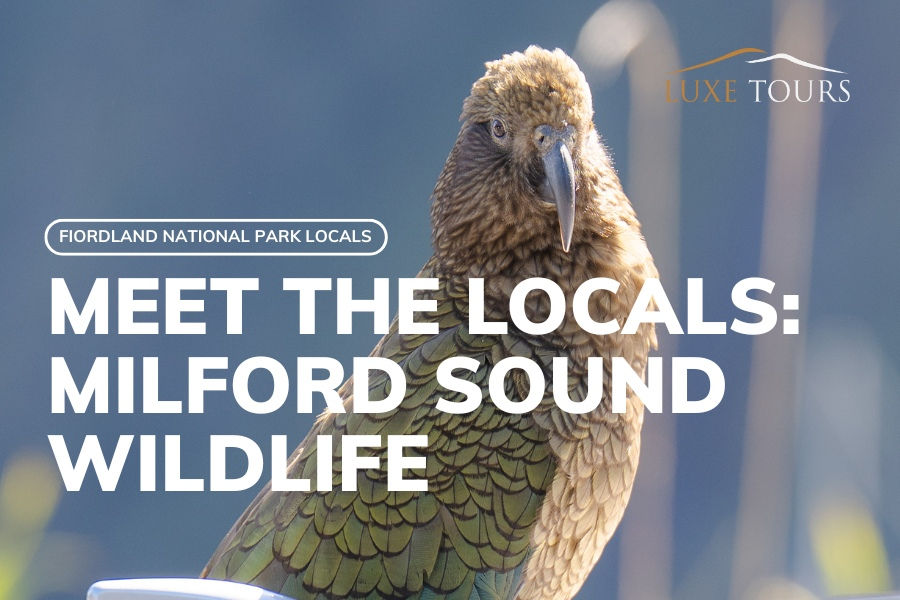
Kea are the world's only alpine parrots and one of the most intelligent bird species on the planet. They're olive-green with orange under their wings, which you can see when they fly overhead.
Kea are famous for their playful and inquisitive nature. They're known for investigating cars, pulling apart windscreen wipers and rubber seals, moving traffic cones, and even solving complex puzzles.
Their call sounds like they're saying their own name, a drawn-out "kee-aaa".
The best places to see kea on a trip to Milford Sound are around the Homer Tunnel area and at the Chasm walk carpark. Make sure you don’t feed them, even if they come close.
Human food harms kea and teaches them to approach people and vehicles, which puts them in danger.
Whio / Blue Duck

Whio are unique waterfowl found only on clean, fast-flowing rivers. They're one of just a few duck species worldwide that live year-round on turbulent whitewater.
They have blue-grey feathers that help them blend in with the river stones. They are rare, with fewer than 3,000 left in the wild, so spotting one is a real privilege.
They're a taonga (highly valuable) species for Māori and even feature on the New Zealand $10 note.
Along the Milford Road, your best chance of seeing them is around the streams near Monkey Creek.
Fiordland Crested Penguin / Tawaki

Tawaki are one of the rarest of New Zealand's mainland penguins, with only around 2,500 to 3,000 breeding pairs left. They're small penguins with dark blue-black feathers and yellow eyebrow stripes that extend from their beak to the back of their head.
Unlike most penguin species, tawaki nest in temperate rainforest right along the coast, often under thick vegetation or in caves and rocky crevices. This makes Fiordland one of the most important habitats for the species.
You may spot tawaki from a Milford Sound cruise, particularly during their breeding season from July to November. They're timid birds, so they'll usually be seen resting on rocks near the shore rather than out in the open.
Responsible Bird Watching
If you're lucky enough to encounter any of these birds, you should give them plenty of space and let them come to you rather than moving towards them.
Never try to touch, hold, or feed a native bird, even the tame ones, such as robins or kea. Human food can be harmful, and feeding wild birds teaches them to approach people and human-made objects, which could put them in danger.
If you're carrying food, keep it stored away so birds like weka and kea aren't tempted to help themselves, and make sure to take any rubbish with you.
From an alpine parrot tampering with cars to a penguin that nests in the rainforest, Fiordland is home to some truly unique birds.
Whether you're deliberately going birdwatching in Fiordland or simply keeping an eye out as you travel the Milford Road, taking the time to notice these birds can give you a greater appreciation of the unique environment that makes Fiordland so special.
Frequently Asked Questions
Will I get to see birds on a Milford Sound tour?
Yes, there are plenty of opportunities to spot native birds on a Milford Sound tour. You may have a better chance on a small group tour, as having fewer people around can make birds more comfortable coming closer. There is also more time on a small group tour to stop and enjoy watching the birds.
What time of year is best for birdwatching in Milford Sound?
There isn't one best time of year for birdwatching in Milford Sound. Native birds are active throughout the year, but you may notice different behaviours and activity depending on the season. For example, parent birds with chicks in spring and early summer (September-December).
What wildlife can you see around Milford Sound?
Milford Sound and the surrounding Fiordland area are home to a wide range of native wildlife. As well as a variety of birds such as kea, tūī, and weka, you may see fur seals resting on the rocks in Milford Sound, and bottlenose dolphins or whales in the fiord waters.